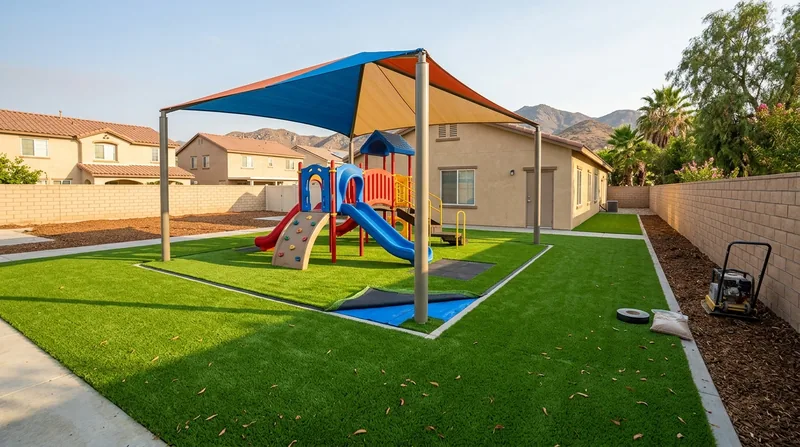




Playground and school turf in Riverside faces a specific challenge: the Inland Empire's intense summer heat, Santa Ana wind exposure, and the wear patterns created by hundreds of children running, jumping and sliding across the same patch of ground every school day. A quality synthetic turf installation built to withstand that traffic and that climate is not a commodity product. Riverside Turf Installation has been installing durable, safety-rated turf for playgrounds and schools across Riverside, Corona, Moreno Valley and the surrounding Inland Empire since 2013. We specify the turf, the infill, the base depth and the fall-height padding in writing before we start, and we build systems that hold up to daily use under 100-degree heat without soft spots, seam separation or drainage failure. Whether you are a school district evaluating a multipurpose field, an after-school program upgrading a worn play area, or a municipality planning a community park in Riverside or Jurupa Valley, we deliver turf that performs.
Why Playground and School Turf Matters in Riverside's Hot, High-Traffic Environment
Riverside playgrounds and school fields sit under relentless sun, often with minimal shade from the scattered California pepper trees and jacarandas that dot the grounds. Real grass browns out by June and compacts into bare dirt by mid-summer under foot traffic and heat stress. A poorly installed synthetic turf system fails in the same conditions: seams split, the pile flattens, infill migrates, drainage clogs and the surface temperature climbs into the range that causes safety concerns. The right artificial turf system, by contrast, handles the heat, drains reliably even under heavy use, resists UV breakdown, and maintains a consistent playing and safety surface year-round without dormancy, bare patches or muddy areas after rain.
- We select turf products rated for high foot traffic, with face weights and pile heights specified for schools and public play areas, not residential yards.
- We install engineered base systems with proper compaction and drainage to handle the water load from Riverside's occasional winter storms without pooling or subsidence.
- We specify infill types and depths that meet ASTM F1292 fall-height standards for impact attenuation, protecting children from injury on hard landings.
- We use seaming techniques and edge treatments that resist the separation and lifting that occurs when high-traffic areas experience thermal expansion and foot traffic stress.
- We design layouts that account for sun exposure, drainage patterns and the specific use zones (running paths, climbing structures, ball courts) where wear is most severe.
A playground or school field turf system must balance durability, safety, drainage and aesthetics in a way that a residential yard installation does not.
Key info: Riverside schools and parks operate under California Department of Education facility guidelines and local building codes. We coordinate with your district or municipality to confirm that turf specifications, infill materials, fall-height padding and base construction align with your safety and performance standards. Our written specifications include face weight in ounces per square yard, pile height in millimeters, infill type and pounds per square foot, base depth and compaction, and ASTM compliance statements where applicable.
For more detail on how safety standards and drainage affect playground turf design, see our sports and gym turf installation page, which covers similar high-performance applications.
How We Install Playground and School Turf in Riverside: A Step-by-Step Process
A playground or school turf installation is a multi-stage project that begins with site assessment and ends with safety testing and handoff documentation. We walk the property, measure the area, identify drainage patterns, assess existing soil and base conditions, and confirm the use zones and fall-height requirements. We then prepare a written scope of work and material specification before we order turf or break ground.
- We request California 811 utility locates to mark underground gas, electric, water and telecom lines before excavation, and we hand-mark private irrigation and low-voltage lighting lines ourselves.
- We remove existing turf, sod or worn synthetic material, and we haul debris off-site or arrange recycling where available.
- We grade and compact the subgrade to proper slope and elevation, addressing any drainage issues, settling or poor base material before we proceed.
- We install a geotextile separation layer and then lay and compact the engineered base material (recycled asphalt, crushed stone or similar) to the depth specified in our design.
- We unroll and position the turf, seam it using industry-standard adhesive and tape, and secure the edges with landscape nails or stakes.
- We infill the turf with the specified material (crumb rubber, silica sand, organic alternatives or combinations) at the depth and density required for performance and safety.
- We brush and rake the infill to distribute it evenly and activate the pile, and we perform a final walk-through to confirm seam integrity, drainage and appearance.
- We provide documentation of materials used, installation date, maintenance guidelines and warranty terms, and we walk your team through the care routine.
The timeline for a typical school or park field ranges from 3 to 7 days depending on area size, existing conditions and weather.
Example: A 5,000-square-foot multipurpose field at a Riverside elementary school in the Wood Streets area required removal of failing real grass, correction of a low spot that pooled water, installation of 6 inches of compacted recycled asphalt base, seaming of three sections of 50-ounce-face-weight turf, and infill with a blend of silica sand and crumb rubber to meet ASTM F1292 fall-height standards for a 12-foot fall zone around climbing equipment. Work took 5 days. The field has operated without seam separation, drainage issues or safety concerns for 2 years.
For details on how we approach repair and maintenance after installation, visit our turf repair and seam repair page.
| Installation Approach | Description | Best For |
|---|---|---|
| New field construction | Full site prep, base installation, turf seaming and infill on bare or graded ground with no existing surface to remove. | New school athletic fields, park expansions, or areas where real grass has failed and soil remediation is needed. |
| Replacement of worn turf | Removal of existing synthetic or real turf, assessment of base condition, repair or reinforcement of base if needed, and installation of new turf and infill. | Playgrounds with 5-10 year old turf showing wear, seam separation, or infill migration; schools upgrading to higher-performance turf. |
| Drainage correction and turf installation | Grading, base layer repositioning, and new turf to resolve ponding, poor drainage or subsurface water issues that affect play safety and surface durability. | Fields in low-lying areas of Riverside or Moreno Valley, properties with clay soils or compacted subgrade, or areas affected by storm water runoff. |
| Modular or sectional installation | Breaking a large field into manageable sections so that portions remain in use while others are being replaced, reducing downtime for active programs. | Schools with year-round or multi-season athletics, or parks where scheduled field closures conflict with program calendars. |
| Specialized infill systems | Installation with antimicrobial or enhanced drainage infill, cooler-rated products, or organic alternatives selected for specific performance, health or environmental goals. | Districts with heat mitigation priorities, programs serving children with sensitivities, or properties where infill environmental impact is a concern. |
Playground and School Turf Cost in Riverside: What to Expect
The cost of a playground or school turf installation in Riverside typically ranges from $10 to $18 per square foot, depending on the turf product selected, the infill system, the existing site conditions and the base depth required. A 5,000-square-foot field might run $50,000 to $90,000 installed; a 10,000-square-foot multipurpose field could range from $100,000 to $180,000. These figures assume standard turf products, engineered base construction and professional seaming. Schools and parks often have budget cycles, grant funding sources and procurement processes that affect timing and scope, and we work within those frameworks.
Several factors move the cost up or down:
- Turf face weight and pile height: higher-performance products rated for extreme foot traffic and safety standards cost more per square foot than commodity turf.
- Infill type: standard silica sand and crumb rubber blends are less expensive than antimicrobial, cooler-rated or organic alternatives.
- Existing site conditions: a field with compacted clay subgrade, poor drainage or low spots requires deeper base work and soil correction, increasing labor and material costs.
- Removal of existing turf: if an old synthetic or real grass field must be torn out and hauled away, that adds labor and disposal cost.
- Access and logistics: fields in tight urban areas of Riverside or Corona may require equipment staging on nearby parking or temporary access routes, adding cost.
- Fall-height padding and safety specifications: if the field is near climbing equipment or elevated structures, additional base thickness or specialized infill may be required to meet ASTM fall-height standards, increasing cost.
The best way to understand the cost for your specific project is to get a free, no-obligation estimate. We measure the area, review the site conditions, confirm your turf and infill preferences and any safety or performance standards, and provide a written quote with a line-item breakdown of materials and labor. Call (951) 783-3353 for a site visit, or visit our full pricing page for more context on how we structure estimates.
Playground and School Turf Near Me: What Riverside Districts and Parks Should Know Before Hiring
Hiring a turf installation company for a school or park project is different from hiring for a residential yard. You are managing public funds, safety liability, performance expectations and often a formal procurement process. Whether you are evaluating Riverside Turf Installation or any other installer, here is what to verify and ask for.
Insurance and liability coverage: Ask for a certificate of general liability insurance and workers' compensation insurance naming your district or municipality as an additional insured. This protects you if someone is injured on the work site or if turf-related damage occurs. Do not hire an installer without proof of insurance.
Written material specification: Get a detailed written spec from the installer before work begins. It must name the turf product, the face weight in ounces per square yard, the pile height in millimeters, the infill type and the pounds per square foot, the base material and depth, and any ASTM compliance statements (e.g., ASTM F1292 for fall-height attenuation). A contractor who cannot or will not provide this in writing is not managing the project professionally.
References and photos: Ask for photos of completed playground or school field projects, and call the references to ask about durability, drainage performance, seam integrity and the installer's responsiveness to maintenance or repair issues after completion. A school in Moreno Valley, Corona or Jurupa Valley that had turf installed 2-3 years ago is a valuable reference.
Permits and regulatory compliance: Confirm whether your project requires a building permit, a grading permit or environmental review with the city or county. The installer should know the process and help coordinate with the building department. In Riverside, grading that changes drainage or affects a right-of-way typically requires a permit; turf itself usually does not. Always defer to your local building department.
Site safety and traffic control: If the field is at an active school or park, ask how the installer will manage pedestrian and vehicle traffic, secure the work zone, and coordinate with your operations team to minimize disruption to programs and access.
Warranty and maintenance documentation: Get a written workmanship warranty (typically one to three years on the installation), and ask for a maintenance guide specific to your turf product and infill. A reputable installer will provide this and be available for questions or minor repairs in the first season.
For a free estimate or to discuss your project, contact Riverside Turf Installation today. We are fully insured and we have been serving Riverside and the Inland Empire since 2013.
Playground & School Turf in Riverside: Pricing Guide
| Service | Price | Details |
|---|---|---|
| Standard playground or school field turf | Starting at $10/sq ft | Fifty-ounce face weight turf, engineered base, standard sand and crumb rubber infill, professional seaming and edge treatment |
| High-performance or safety-rated turf | Starting at $14/sq ft | Premium turf products, thicker base, ASTM F1292 fall-height padding or antimicrobial infill, enhanced drainage for high-traffic zones |
| Site prep, drainage correction or base reinforcement | Starting at $3/sq ft | Grading, clay removal, base layer installation or replacement, compaction and drainage improvement before turf installation |
| Removal of existing turf | Starting at $1.50/sq ft | Tear-out, haul-away and disposal or recycling of old synthetic or real grass, site cleanup and preparation for new installation |
| Large-scale or complex projects | On estimate | Multi-section fields, phased installations, specialized infill systems or sites with difficult access or drainage require site measurement and written proposal |
| Free estimate | No obligation | Site visit, measurement and written quote within 24 hours, call (951) 783-3353 for appointment |
Indicative pricing, the exact cost depends on square footage, finish, and site access. Free personalized estimate within 24h at (951) 783-3353.


